How long has sEMG been used in rehabilitation?
Surface electromyography (sEMG) is a non-invasive technology that detects electrical activity from muscles through sensors placed on the skin. When a muscle contracts, it emits a small electrical signal. In some muscles, we can detect this electrical signal from the skin’s surface using specialised sensors.
sEMG has been around for a long time, and widely used by physiotherapists for rehab since the 70s. They always get the cool toys first! Now, there’s a growing community of Speech and Language Pathologists and researchers using sEMG in swallowing care.
Which muscles does sEMG measure during swallowing?
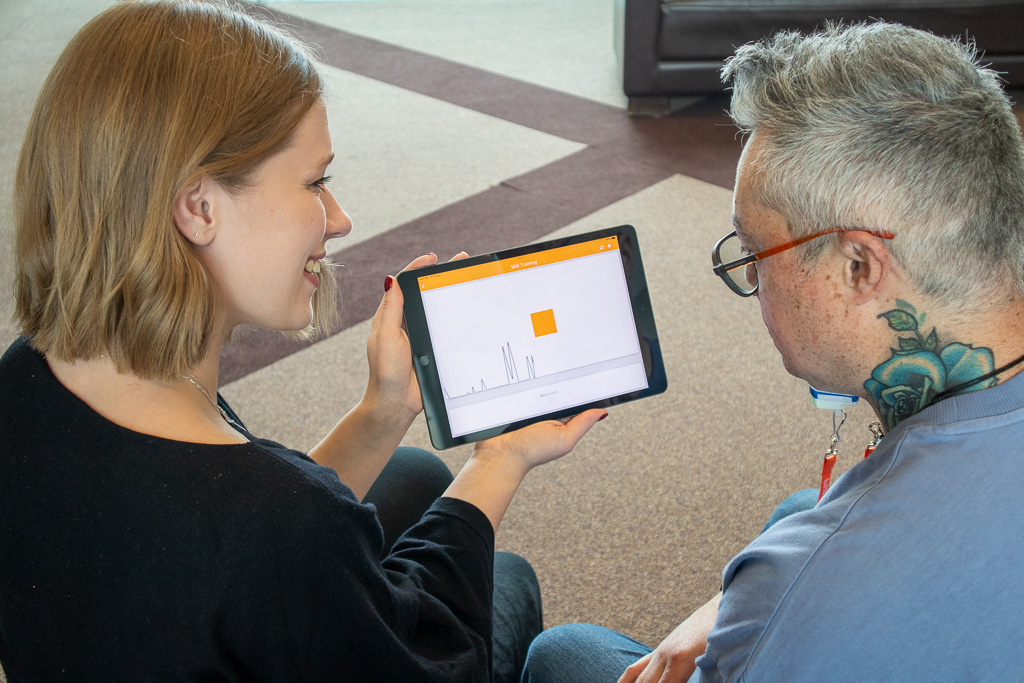
With an sEMG system like BiSSkApp, a sensor is placed under the chin, where it can pick up signals from muscles that are used when swallowing: the mylohyoid, the geniohyoid, and the anterior belly of the diagastric. When you swallow and these muscles contract, the electrical signals generated are displayed as a waveform on a screen. The harder they contract, the signal gets stronger, and the waveform on the screen goes higher.
Why does swallowing rehabilitation need biofeedback?
Swallowing is a hidden skill, and not something you think about much. When it goes wrong, it can be very difficult to understand what is happening, or feel anything in the area. Doing rehab without biofeedback like this is a bit like trying to play golf with a blindfold on – you’re trying to get the ball in the hole, but without feedback, you don’t always know how well you did or what you need to change to do better.
What can you do once you can see your swallow?
This biofeedback lets you “see their swallow”, so you can build a brain-muscle connection, better understand anything that isn’t working quite right when you swallow, and learn to make adjustments and swallow better.
Why is sEMG training more engaging than standard swallowing exercises?
It’s also a lot more fun than other exercises – instead of staring into space and doing your training, you can play what feels like a game, that’s helping you swallow better!
This approach draws on principles of motor learning and experience-dependent neuroplasticity, where repeated, meaningful practice and feedback can support changes in how the brain controls movement.
FAQ
What does sEMG measure during swallowing?
Using sEMG for swallowing can give you information on:
- When you’re using your swallowing muscles
- How much force those muscles are using when you swallow – also known as amplitude
- The timing of your swallowing activity
- The impact of different swallowing strategies or manoeuvres
- Changes in the sEMG signal over repeated practice
Is sEMG the same as NMES?
No, though they’re often confused, especially as there are devices available that do both! Where NMES (neuromuscular electrical stimulation) is generating electrical impulses to stimulate muscles, sEMG only detects electrical signals emitted by muscles contracting.
Can sEMG be used at home?
Yes, sEMG systems like BiSSkApp are designed to be used independently by patients at home for swallowing therapy, with remote monitoring by a clinician.
Can sEMG be used for diagnosis of swallowing problems?
No. sEMG measures muscle electrical activity; it does not by itself diagnose dysphagia or provide a complete picture of swallowing physiology. Clinical assessment and, where appropriate, instrumental assessment such as VFSS or FEES are needed to evaluate swallowing function.
Is sEMG safe?
sEMG is non-invasive because the electrodes detect electrical activity through the skin rather than delivering electrical stimulation to the muscles.
Can sEMG be used for dysphagia?
Yes. sEMG has been used as a biofeedback tool in dysphagia management and swallowing therapy, including research involving people with post-stroke dysphagia and Parkinson’s disease.
Does sEMG strengthen swallowing muscles?
sEMG itself does not strengthen muscles. Instead, sEMG can provide feedback that helps a person practise specific swallowing movements or generate a target level of muscle activity. The training task determines the intended therapeutic effect.
Does sEMG help with swallowing timing, coordination, or skill?
Yes, sEMG biofeedback provides real-time information about muscle activity, which can help people practise the timing, coordination and precision of swallowing movements. Rather than simply trying to make a muscle stronger, the person can use the visual feedback to understand how they are performing a swallowing task, make adjustments, and practise the movement repeatedly. This makes sEMG particularly relevant to skill-based approaches to dysphagia therapy.
Are there any contraindications for using sEMG for swallowing therapy?
For BiSSkApp, the primary contraindication is application to broken skin. There are also circumstances where a clinician may need to consider whether sEMG is appropriate or whether the signal will be reliable.
Skin condition – if you have rashes, scarring, or other things that impact your skin quality, it may be difficult to find unimpacted areas to apply an sEMG sensor, or using adhesives required to apply the sensor may cause issues.
Deep Brain Stimulation – some people with DBS implants are using them at the same electrical frequency as muscle activity. This doesn’t mean using sEMG will interfere with the DBS, but it does mean that the DBS may cause noise and interfere with the signal that you’re trying to see your swallow on.